Introduction to Microsoft Azure Arc and its Multi-Cloud Capabilities
 Niten Devalia
Chief Sales Officer / Co-founder • Sep 23, 2021 • 5 min read
Businesses today are finding it difficult to sail through multiple complex environments that run across data centers, multiple cloud, and edge. With the deployment of hybrid cloud infrastructures, many players like AWS, Google, and Microsoft have entered the market to bring out innovation. With each one building control panels to manage and deliver the promise of the multi cloud technologies in this ever-changing infrastructure. However, Microsoft Azure Arc stands out amongst others because of its unique architectural design. In this article, we will dive deep into the efficacy of Microsoft Azure Arc.
What is Azure Arc?
Azure Arc is a software solution that enables you to project the on-premise and other cloud resources such as physical or virtual servers and Kubernetes clusters. Essentially Azure Arc is an extension of Azure Resource Management (ARM) that acts as a management and governance tool to enable you to manage your resources as if they are running in Azure using a single panel across your estate. It is about extending the Azure control panel to manage the resources beyond Azure like Kubernetes, Virtual Machines or wherever they are either Windows, Cloud Native, or Linux. Enterprises can manage resources even if they are not always connected to the internet. Hence, non-Azure management can also be managed along with Azure deployments using the same interface and services.
What does Azure Arc offer?
- Arc enables the governance and management of resources that reside virtually anywhere. These resources can be virtual machines, servers, SQL databases, or even the Kubernetes clusters. You can use the familiar Azure services and management capabilities to manage data using Arc.
- Azure arc enables businesses to easily modernise multi-cloud and on-premise operations through a plethora of Azure managed and governed services.
- Arc allows organisations to extend the adoption of the consistent framework and toolset for identity, DevOps, security, and automation capabilities across the hybrid infrastructures.
- Arc allows enterprises to make the right decision about their cloud migrations saving significant time, effort, and migration costs.
- Arc also provides benefits of the cloud such as fast deployment and automation at scale. For example, by using Kubernetes orchestration, you can deploy a database in seconds by utilising tools.
- Arc enables a unified experience whether you are using Azure PowerShell, Azure portal, or Azure REST API.
Features of Azure Arc
Whether it is a small business exploring cloud feasibility or large-scale enterprises with footprints across multiple clouds, Azure Arc capabilities extend to multiple use cases.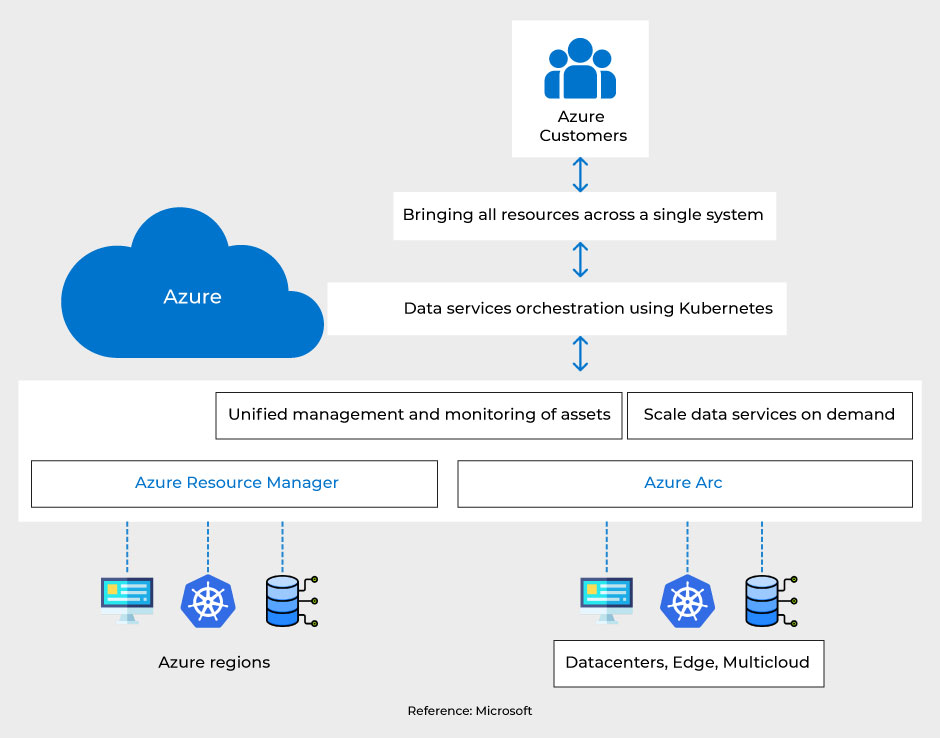
- Manage server configurations Servers, whether it is physical or virtual machines, Linux or Windows are all supported by Azure Arc. These servers enable different configurations, management, and monitoring tasks, making it easier for the hybrid systems to have better resource management. When a hybrid machine is connected to Azure, it becomes a connected machine and is then considered as a resource of Azure.
- Self-service orchestration with Kubernetes Azure Arc enables managing your Kubernetes clusters both inside and outside the Azure ecosystem. With this, anyone can use Arc to connect and configure any Kubernetes cluster across customer data center, multi-cloud, and edge locations.
- Run data services on any infrastructure Keep the on-premise databases up to date while maintaining control with Azure Arc enabled data services. It also supports cloud-like elastic scale that can support a burst scenario that requires data in real-time. This capability also provides an additional boost to the companies to run their Azure data on any infrastructure.
- Azure Arc enabled SQL server Arc also combines the SQL server database hosted outside of Azure either within your datacenter, on the edge, or in the multi-cloud environment. This service can be created on your choice of infrastructure that hosts the Arc enabled data services.
- Unified management and simplified monitoring All the data assets connected to Azure Arc are managed through a centralised platform of Azure. This allows easier integration with the existing automation tools and simplifies governance spanning across different clouds.
Azure Arc Considerations
As Arc data services can work on any platform including the Kubernetes, it can also work on two different connectivity modes:
Directly Connected: In this direct mode, the connection is initiated from the source to Azure, and data is also continuously sent to Azure. This mode is suited for workloads that are deployed in edge locations, data centers, and cloud platforms.
Indirectly Connected: This mode does not require a direct connection with Azure. As there is no direct connectivity, it also doesn’t offer a full range of direct management solutions from Azure. This indirect connect mode is suited for cases where there is limited access to the internet.
Summary
The growing demand for hybrid cloud platforms has ushered Microsoft to launch Azure Arc as a part of its cloud services.
So, what does such an innovation mean for IT infrastructure? Well, with the ever-rising demands of a multi-cloud environment, this seems like more than a viable option. Simply because Arc enables organisations to jump into the hybrid cloud bandwagon regardless of whether they own older or a new version of operating systems. This strategy is a game changer as it helps to simplify complex systems across various environments like on-premise, multi-cloud, and edge. Additionally, Arc can also be deemed as a great choice for organisations that want to maintain a balance between traditional workloads and modernised container-based workloads.
Azure Arc can hence distinguish itself as a management tool for hybrid cloud applications driving digital transformations. Call on 1300 EXIGOTECH (394 468) or email at sales@exigoteh.com.au to talk to one of our experts to discuss how we can bring digital transformation to your organisation.



Let's Talk About Your IT Challenges
Book a free consultation with our experts today. We'll analyze your current infrastructure and provide actionable recommendations.