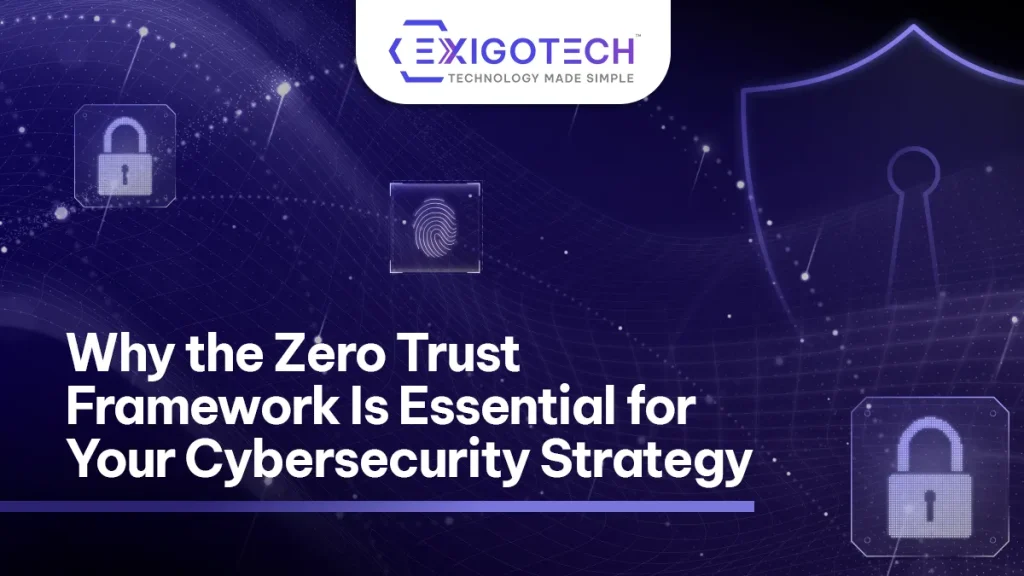
Why the Zero Trust Framework Is Essential for Your Cybersecurity Strategy
 Niten Devalia
Chief Sales Officer / Co-founder • Jul 17, 2025 • 6 min read
According to the Australian Cyber Security Centre (ACSC), a cybercrime is reported every 6 minutes. Plus, 52% of vulnerabilities in 2024 were related to initial access, as per the CrowdStrike 2025 global threat report. The report also states that there is 35% year-over-year increase in interactive intrusion campaigns in 2024.
Even more alarming, the average cost of a single data breach in Australia topped AU$4 million in 2024.
These stats highlight a critical truth: trust is no longer a valid cybersecurity strategy.
The Zero Trust Framework flips the traditional model. It assumes breach, treats every request as a potential threat, and continuously validates every user and device, whether inside or outside the organisation.
In this blog, we will discover how Zero Trust works, why it matters more than ever, and how Exigo Tech empowers every business to implement this model effectively.
How to Secure Microsoft Copilot Agents with Microsoft 365 E5
What Is Zero Trust Architecture?
Zero Trust Architecture is a cybersecurity model built around a simple principle: Never trust, always verify.
In a Zero Trust model, no user or device is trusted by default, even if they’re already inside the network perimeter. Every request is authenticated, authorised, and encrypted before access is granted.
By adopting a Zero Trust Architecture, you can:
- Minimise exposure to cyber threats across your digital ecosystem.
- Validate each user and device before allowing entry to critical resources.
- Safeguard distributed teams operating beyond traditional office boundaries.
- Ensure regulatory obligations are consistently met.
- Monitor activity in real time to strengthen overall security posture.
Zero Trust Is a Mindset, Not Just a Technology
Zero Trust isn’t just a tool or a product; it’s a smarter way to keep your business safe. Instead of assuming everything inside your network is safe, it treats every user, device, and request with caution.
Think of it like locking every door in your house, not just the front door. You check who someone is and whether they should be there, every time.
This approach helps your business:
- Stay protected even if a hacker gets past one layer of defence
- Support remote work and cloud services without adding risk
- Make sure only the right people can access sensitive data
Moving to Zero Trust might seem like a big change, but it can be done step by step. And with the right support, it’s easier than you think.
Agentic AI for Operations Leaders: Turning AI into Action
Why Traditional Cybersecurity Is No Longer Enough
Traditional cybersecurity strategies were built for a centralised IT environment that typically includes office-bound staff, fixed devices, and clearly defined perimeters.
Today, most organisations:
- Use cloud services
- Allow remote work
- Connect third-party systems
- Store sensitive data across multiple platforms
This complexity introduces blind spots. If a single point fails, attackers can move freely within the network.
Zero Trust stops this. It enforces continuous validation and limits how far an attacker can go even after gaining access.

Benefits of Zero Trust Architecture
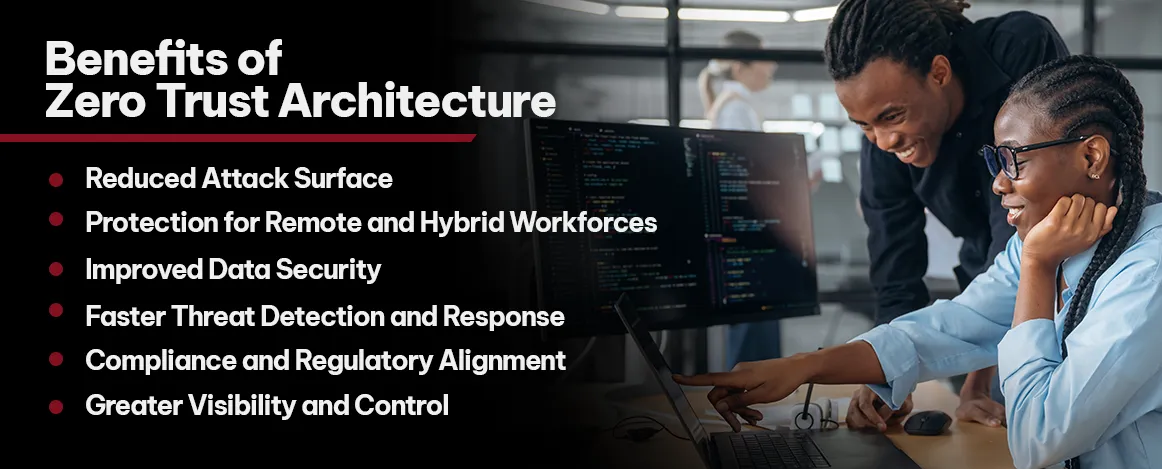
By adopting Zero Trust Architecture, you gain a proactive cybersecurity posture that adapts to evolving threats. This approach not only safeguards critical assets but also builds trust with customers and regulators by demonstrating a commitment to strong, modern cybersecurity practices.
- Reduced Attack Surface
Every device, user, and application is treated as a potential risk. - Protection for Remote and Hybrid Workforces
Strong access control policies apply regardless of user location. - Improved Data Security
Sensitive data is segmented, encrypted, and only accessible to verified users. - Faster Threat Detection and Response
Behavioural analytics and real-time monitoring detect anomalies early. - Compliance and Regulatory Alignment
Supports Essential Eight, ISO 27001, ACSC guidelines, and more. - Greater Visibility and Control
Continuous monitoring and granular policy enforcement give IT teams real-time insights into network activity and potential threats.
Cybersecurity Zero Trust Architecture: A Layered Approach
Implementing Zero Trust is not just a technical exercise – it’s a strategy.
A mature Zero Trust model considers:
- User identity and access control
- Device health and management
- Application-level micro-segmentation
- Continuous monitoring and response
- Data loss prevention (DLP)
At Exigo Tech, we deliver Zero Trust solutions aligned to your compliance requirements and industry context.

Microsoft 365 Security for Healthcare Providers: Protecting Patient Data and Business Operations
How to Implement Zero Trust: A Practical Roadmap
Transitioning to a Zero Trust model isn’t about replacing everything overnight; it’s about evolving your existing cybersecurity strategy step by step. Here’s how businesses can begin the journey:
- Assess Current Security: Identify vulnerabilities and access gaps in your existing environment.
- Strengthen Identity and Access: Enforce strong identity checks and least-privilege access.
- Segment the Network: Divide your network into controlled zones to limit threats.
- Monitor Continuously: Use real-time monitoring and analytics for rapid threat detection.
- Protect Data: Encrypt sensitive data and control access to important assets.
- Choose the Right Partner: Work with a partner like Exigo Tech to implement scalable Zero Trust solutions.
Why Choose Exigo Tech for Your Zero Trust Journey?
At Exigo Tech, we help businesses of all sizes design and deploy Zero Trust strategies customised to their specific risk profile and operational needs. Our team brings:
- Deep expertise in implementing Essential Eight, ISO 27001 standards, ACSC control, and other security frameworks.
- Customised implementation plans that align with your business goals and existing infrastructure.
- Advanced threat detection and response solutions that integrate seamlessly across cloud and on-prem environments.
- Ongoing support and optimisation to ensure your Zero Trust architecture evolves with your business and the threat landscape.
Get Started with Our Zero Trust Security Assessment
The Zero Trust Framework isn’t a one-time deployment – it’s a continuous strategy. At Exigo Tech, we simplify the process through our Zero Trust Security Assessment. Powered by Microsoft, our assessment gives you a clear picture of your current security posture and shows you exactly what steps to take next.
Let Exigo Tech help you design and implement a Zero Trust strategy that works for your business.
Frequently Asked Questions (FAQs)
- What is Zero Trust Architecture?
Zero Trust Architecture is a cybersecurity model that eliminates implicit trust. Every user, device, and connection must be verified before access is granted.
- How does Zero Trust Architecture handle encrypted traffic?
Zero Trust frameworks use deep packet inspection and TLS termination at key gateways to inspect encrypted traffic. Threats hiding in encrypted traffic are detected via advanced threat analytics.
- How does Zero Trust Architecture handle insider threats?
It limits access using least-privilege policies, monitors user behaviour and spots unusual actions.
- What are the best practices for implementing Zero Trust Architecture?
- Conduct regular risk assessments
- Apply MFA everywhere
- Enable conditional access policies
- Continuously monitor user and device activity
- Use automation for incident response
- What are the five pillars of Zero Trust Architecture?
The five pillars are:
- Identity
- Devices
- Applications
- Data
- Network and Infrastructure
Each pillar must be secured, monitored, and controlled under Zero Trust.
- What are the main challenges in implementing Zero Trust Architecture?
- Legacy systems integration
- Complexity in policy creation
- Lack of internal expertise
- Budget and timeline constraints
Exigo Tech helps clients overcome these challenges with structured rollouts and customised advisory services.
Table of Contents
Tags
Related Articles

Microsoft 365 Security for Healthcare Providers: Protecting Patient Data and Business Operations
Endpoint Security for SMBs: Protecting Devices, Users and Business Data

Compliance and Cybersecurity Challenges Facing Australian Local Governments

Let's Talk About Your IT Challenges
Book a free consultation with our experts today. We'll analyze your current infrastructure and provide actionable recommendations.