- Technologies
- Dynamics 365 Business Central Workshop
- Dynamics 365 Supply Chain Management Workshop
- Dynamics 365 Finance Readiness Assessment
- Dynamics 365
- Customer Data Platform
- Dynamics 365 Sales
- Dynamics 365 Service
- Dynamics 365 Marketing
- Dynamics 365 Supply Chain Management
- Dynamics 365 Business Central
- Dynamics 365 Finance
- Dynamics 365 Project Management
- Modern Application Development
- Dynamics 365 for Sales Workshop
- Innovation
- Contact us
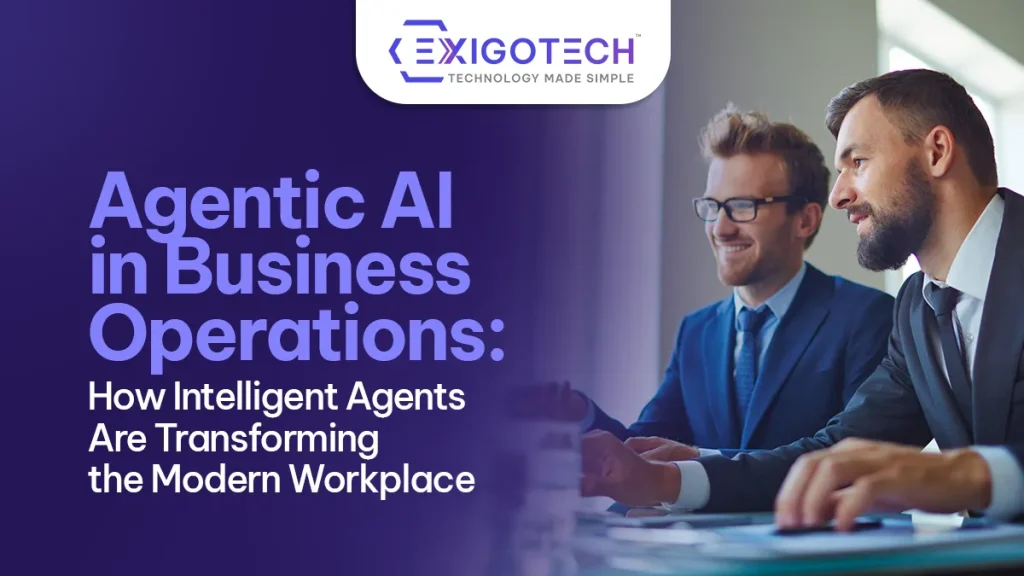
Agentic AI in Business Operations: How Intelligent Agents Are Transforming the Modern Workplace
 Niten Devalia
Chief Sales Officer / Co-founder • Jul 10, 2026 • 5 min read
Artificial Intelligence has evolved rapidly over the past few years.
Businesses initially adopted AI to generate content, summarise meetings, analyse data, or automate simple tasks. While these capabilities delivered measurable productivity gains, the next stage of AI evolution is now reshaping how organisations operate. And that evolution is Agentic AI.
Unlike traditional AI assistants that respond to prompts, agentic AI systems can reason, plan, make decisions, and complete multi-step tasks with minimal human intervention. They don’t just assist employees; they actively perform work across business applications, workflows, and departments.
As organisations move beyond AI experimentation, Agentic AI is becoming a key driver of operational efficiency, business agility, and digital transformation.
At Exigo Tech, we help organisations adopt AI securely and strategically as their Managed Intelligence Partner, ensuring Agentic AI delivers measurable business value while maintaining governance, security, and operational control.
How to Secure Microsoft Copilot Agents with Microsoft 365 E5
What Is Agentic AI?
Agentic AI refers to AI systems that can independently perform tasks on behalf of users or organisations.
Rather than answering a single question, an AI agent can:
- Understand objectives
- Break work into multiple steps
- Interact with different business systems
- Make decisions based on defined rules
- Execute workflows
- Learn from previous outcomes
- Escalate exceptions to human users when required
In practical terms, Agentic AI behaves more like a digital team member than a traditional chatbot.
Why Agentic AI Is Gaining Momentum
The rapid adoption of Microsoft 365 Copilot, AI assistants, and enterprise automation platforms has shown businesses what’s possible with AI.
However, organisations quickly realised that employees still spend significant time moving information between systems, chasing approvals, updating records, and coordinating repetitive work.
Agentic AI addresses these challenges by orchestrating entire business processes rather than isolated tasks.
As AI platforms mature throughout 2026, organisations are increasingly deploying specialised agents across finance, HR, operations, customer service, procurement, IT, and more.
How Agentic AI Supports Business Operations
Agentic AI is designed to automate business processes rather than individual activities.
Examples include:
Employee Onboarding
Instead of manually coordinating onboarding activities, an AI agent can:
- Create user accounts
- Assign Microsoft 365 licences
- Schedule induction sessions
- Generate documentation
- Notify relevant departments
- Track onboarding completion
This significantly reduces administrative effort while improving consistency.
Customer Service
AI agents can:
- Respond to routine enquiries
- Retrieve customer information
- Escalate complex cases
- Update CRM systems
- Generate follow-up communications
Human teams remain involved where judgement or relationship management is required.
Finance and Procurement
Agentic AI can assist with:
- Invoice processing
- Purchase approvals
- Vendor onboarding
- Expense validation
- Budget reporting
Rather than replacing finance professionals, AI helps eliminate repetitive administrative tasks.
IT Operations
Within IT environments, AI agents can:
- Monitor infrastructure
- Identify anomalies
- Create service tickets
- Recommend remediation actions
- Execute approved automation workflows
This enables IT teams to focus on higher-value strategic initiatives.
Agentic AI for Operations Leaders: Turning AI into Action
Agentic AI and Microsoft Ecosystem
Many organisations are building Agentic AI capabilities using Microsoft’s AI ecosystem.
Technologies such as:
- Microsoft 365 Copilot
- Copilot Studio
- Azure AI
- Power Automate
- Microsoft Fabric
- Microsoft Dataverse
allow businesses to create AI agents that securely interact with organisational data and business applications.
When implemented correctly, these agents operate within existing Microsoft security, identity, and compliance controls.
This makes governance significantly easier than relying on disconnected third-party AI tools.
The Business Benefits of Agentic AI
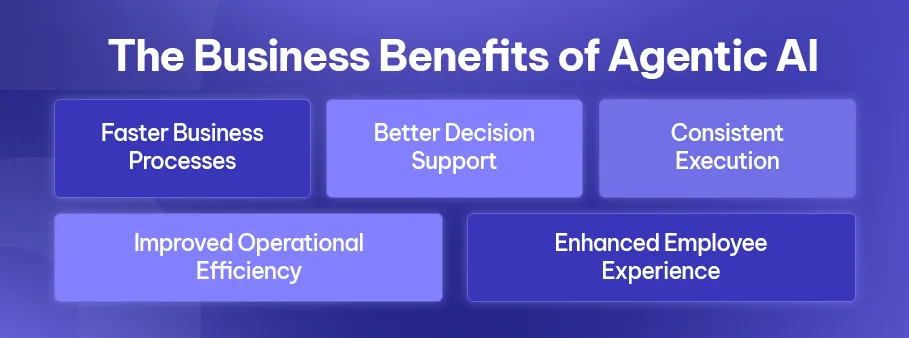
Organisations adopting Agentic AI are seeing benefits that extend beyond productivity improvements.
-
Faster Business Processes
Multi-step workflows that previously required multiple employees can now be completed automatically.
-
Improved Operational Efficiency
Routine administration is reduced, allowing employees to focus on strategic work.
-
Better Decision Support
AI agents can collect, analyse, and present information from multiple systems, helping decision-makers respond more quickly.
-
Consistent Execution
Automated processes follow predefined business rules, reducing human error and improving compliance.
-
Enhanced Employee Experience
Employees spend less time on repetitive work and more time on activities that require creativity, collaboration, and critical thinking.
Governance Is Critical
Despite its potential, Agentic AI introduces new governance considerations.
AI agents often interact with:
- Microsoft 365
- CRM systems
- ERP platforms
- Financial systems
- Customer databases
- Internal documents
Without appropriate governance, organisations risk:
- Over-permissioned AI agents
- Unauthorised data access
- Compliance issues
- Poor decision transparency
- Inconsistent business outcomes
Strong governance frameworks help ensure AI operates securely and responsibly.
Microsoft 365 Security for Healthcare Providers: Protecting Patient Data and Business Operations
Preparing Your Organisation for Agentic AI
Successful adoption requires more than deploying AI technology.
Organisations should first establish strong foundations.
-
Review Data Governance
AI performs best when data is:
-
- Well organised
- Properly classified
- Securely managed
- Accessible through appropriate permissions
Solutions such as Microsoft Purview play an important role in protecting sensitive information.
-
Optimise Identity and Access Management
AI agents should operate using least-privilege principles.
Microsoft Entra ID helps organisations manage identities, authentication, and access controls consistently.
-
Identify Suitable Business Processes
Not every workflow should be automated.
The best candidates are:
-
- Repetitive
- Rules-based
- High-volume
- Time-consuming
- Cross-functional
Starting with targeted use cases often delivers the fastest return on investment.
-
Maintain Human Oversight
Agentic AI should enhance human decision-making, not replace it entirely.
Critical business decisions should continue to include appropriate review and approval processes.
Human oversight helps maintain accountability while improving trust in AI-driven operations.
Common Challenges
Organisations often encounter several challenges during adoption.
-
Legacy Processes
Older manual workflows may require redesign before automation.
-
Data Quality
Poor-quality information limits AI effectiveness.
-
Change Management
Employees need confidence that AI supports rather than replaces their work.
-
Security and Compliance
AI should be introduced within established governance frameworks to minimise organisational risk.
Addressing these challenges early creates a stronger foundation for long-term AI success.
Why Choose Exigo Tech as Your Managed Intelligence Partner
At Exigo Tech, we help organisations move beyond AI experimentation to practical business transformation.
As your Managed Intelligence Partner, we provide:
- Agentic AI strategy and consulting
- Microsoft 365 Copilot readiness assessments
- Copilot Studio implementation
- AI governance and policy development
- Microsoft Purview data governance
- Power Platform automation solutions
- Microsoft Azure AI consulting
- Ongoing managed services and optimisation
Our approach focuses on helping organisations adopt Agentic AI securely, strategically, and with measurable business outcomes.
Table of Contents
Tags
Related Articles

How to Secure Microsoft Copilot Agents with Microsoft 365 E5
Agentic AI for Operations Leaders: Turning AI into Action

When Should You Use Agent Builder Instead of Copilot Studio?

Let's Talk About Your IT Challenges
Book a free consultation with our experts today. We'll analyze your current infrastructure and provide actionable recommendations.