- Technologies
- Dynamics 365 Business Central Workshop
- Dynamics 365 Supply Chain Management Workshop
- Dynamics 365 Finance Readiness Assessment
- Dynamics 365
- Customer Data Platform
- Dynamics 365 Sales
- Dynamics 365 Service
- Dynamics 365 Marketing
- Dynamics 365 Supply Chain Management
- Dynamics 365 Business Central
- Dynamics 365 Finance
- Dynamics 365 Project Management
- Modern Application Development
- Dynamics 365 for Sales Workshop
- Innovation
- Contact us
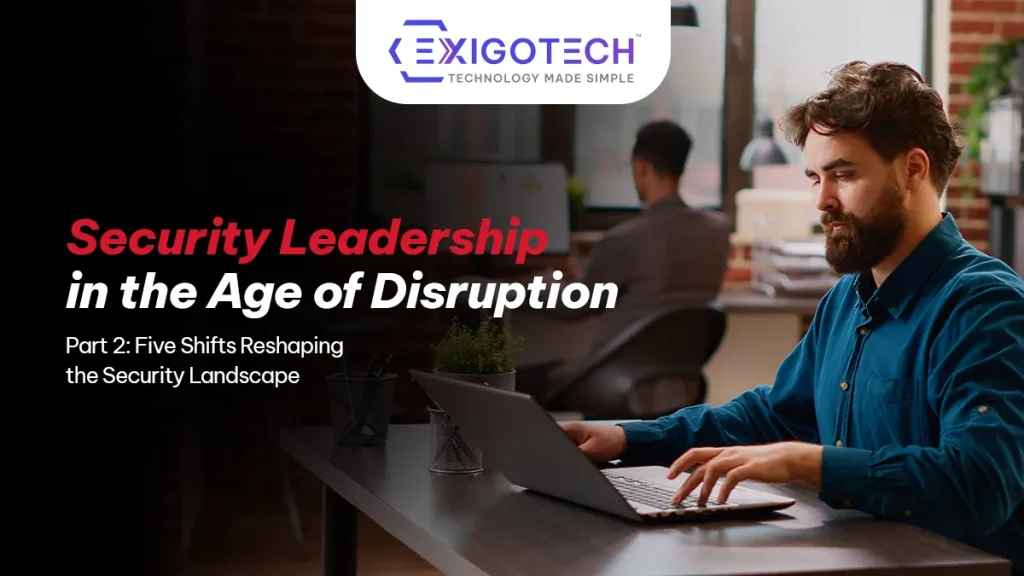
Security Leadership in the Age of Constant Disruption – Part 2: Five Shifts Reshaping the Security Landscape
 Niten Devalia
Chief Sales Officer / Co-founder • Sep 8, 2025 • 5 min read
In Part 1 of this series, we explored why security has become a strategic imperative in today’s era of constant disruption. The stakes have never been higher.
Here’s what the numbers show:
- According to the Logicalis 2025 CIO report, 88% of organisations suffered at least one cybersecurity incident in the past year, and 43% which means almost half of them experienced multiple breaches – a sign that volume alone no longer ensures protection.
- 74% of organisations reported a security breach in the last year due to insecure coding practices—highlighting the rising risk tied to AI-generated and human-devised code vulnerabilities.
- 51% of security professionals have seen an increase in deepfake and executive-targeted attacks, increasing the pressure on digital identity protection.
These figures signal a harsh truth: disruption is the new normal. Security leaders must stay ahead and ready before the threats arrive.
In this Part 2 of the series, we discuss the five major shifts redefining the security landscape. These are more than technical trends. They demand a strategic mindset that bridges leadership, innovation, and business resilience.
How to Secure Microsoft Copilot Agents with Microsoft 365 E5
Five Shifts Reshaping the Security Landscape
-
AI Agents: Productivity Meets Risk
AI agents are redefining how your enterprises operate. They automate workflows, generate insights, and support decision-making. For many organisations, AI agents have become critical enablers of productivity and innovation.
But with these benefits come serious risks:
- Autonomous actions can be exploited if governance is weak.
- Data exposure increases as agents connect across systems and datasets.
- Generative misuse can lead to misinformation, impersonation, and fraud at scale.
Security teams must now extend their focus from human identities to machine identities and agent behaviour. AI governance, monitoring, and ethical controls must evolve in parallel with adoption. CIOs and CISOs need frameworks that allow AI to scale responsibly, delivering productivity gains while containing risk.
-
Cyber-physical Systems: Expanding the Attack Surface
From connected vehicles and smart buildings to energy grids and manufacturing plants, these systems blur the line between digital infrastructure and physical operations.
This convergence expands the attack surface in ways that traditional IT security was not designed to handle.
- Attacks now disrupt not just data, but physical outcomes like supply chains or patient care.
- The perimeter is no longer a single network but spans sensors, devices, and embedded systems.
Protecting cyber-physical environments requires a unified strategy that accounts for both digital assets and physical resilience.

-
Quantum Computing: A Retroactive Threat
Quantum computing holds great promise for breakthroughs in science, logistics, and finance. But for cybersecurity leaders, its most pressing implication is risk. Once sufficiently advanced, quantum machines could break widely used cryptographic algorithms.
This creates a retroactive threat: data stolen today could be decrypted tomorrow. Sensitive intellectual property, national security data, or customer information may already be at risk.
The challenges are clear:
- Encryption standards in use today will not survive quantum attacks.
- Data theft now could have consequences years into the future.
- Transitioning to post-quantum cryptography demands time, planning, and coordination.
Strategic leaders must include quantum resilience in their long-term roadmap. The question is not if, but when.
Agentic AI for Operations Leaders: Turning AI into Action
-
AI-enabled Workforces: Identity and Access Redefined
As AI becomes embedded in daily workflows, the workforce itself is transforming. Employees collaborate with AI copilots, machine learning models, and automation platforms. This shift redefines identity and access:
- Identity management must expand beyond humans to include non-human actors.
- Access controls must adapt dynamically to changing roles and machine-driven tasks.
- Training and awareness must prepare employees to use AI responsibly.
The result is a hybrid workforce of people and intelligent systems. Security leaders must evolve from managing static credentials to delivering continuous verification and adaptive access. CIOs and CISOs also carry responsibility for shaping culture, ensuring employees understand both the benefits and risks of working alongside AI.
-
Hardware-level Security: Building from the Ground Up
Recent attacks have highlighted vulnerabilities not just in software but in hardware and firmware. Exploits at the processor or chip level bypass traditional defences and compromise entire ecosystems.
Enterprises must adopt a hardware-rooted approach to resilience:
- Secure boot processes and trusted platform modules (TPMs) safeguard integrity.
- Firmware checks and robust update mechanisms protect against compromise.
- Vendor collaboration ensures that hardware supply chains remain trusted.
This shift requires deeper partnerships between IT, security, and engineering teams. Building security from the ground up, not just layering it on software, will define enterprise resilience in the years ahead.

Microsoft 365 Security for Healthcare Providers: Protecting Patient Data and Business Operations
Looking Ahead
These five shifts are not isolated. They are interconnected, accelerating, and redefining the fundamentals of enterprise resilience. Together, they demand a new mindset, one that positions security not as a barrier to innovation but as its foundation.
Business leaders who understand and act on these shifts will be best positioned to thrive in disruption. Those who hesitate risk falling behind in both resilience and competitiveness.
In Part 3 of this series, we will move from disruption to action. We will outline five practical strategies every enterprise can adopt to strengthen resilience.
These strategies will help leaders translate awareness into measurable outcomes and build a security posture fit for the future.
Table of Contents
Tags
Related Articles
Microsoft 365 Security for Healthcare Providers: Protecting Patient Data and Business Operations
Endpoint Security for SMBs: Protecting Devices, Users and Business Data

Compliance and Cybersecurity Challenges Facing Australian Local Governments

Let's Talk About Your IT Challenges
Book a free consultation with our experts today. We'll analyze your current infrastructure and provide actionable recommendations.