
- Technologies
- Dynamics 365 Business Central Workshop
- Dynamics 365 Supply Chain Management Workshop
- Dynamics 365 Finance Readiness Assessment
- Dynamics 365
- Customer Data Platform
- Dynamics 365 Sales
- Dynamics 365 Service
- Dynamics 365 Marketing
- Dynamics 365 Supply Chain Management
- Dynamics 365 Business Central
- Dynamics 365 Finance
- Dynamics 365 Project Management
- Modern Application Development
- Dynamics 365 for Sales Workshop
- Innovation
- Contact us
Microsoft Copilot Agents: Real Business Use Cases for Australian Organisations
 Ben Opit
Business Transformation Lead - MS Biz App and AI • Oct 2, 2026 • 6 min read
AI is moving beyond simple chatbots and productivity assistants.
Australian organisations are increasingly exploring AI agents that can answer questions, access business information, complete tasks, and support processes with less manual intervention.
Microsoft Copilot Studio enables organisations to build and manage these agents, connect them to business data and systems, and deploy them across channels such as Microsoft Teams, Microsoft 365 Copilot, SharePoint, and websites.
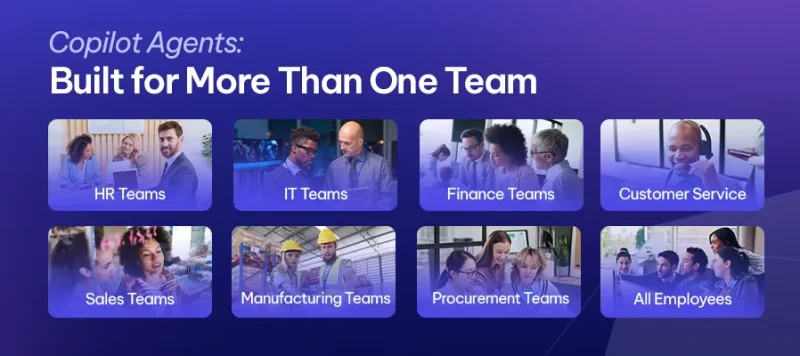
For Australian organisations, potential applications span customer service, HR, finance, IT, sales, manufacturing, procurement, and more.
At Exigo Tech, we help organisations identify, build, govern, and optimise practical AI agent use cases as their Managed Intelligence Partner, connecting AI adoption to measurable business outcomes.
How to Secure Microsoft Copilot Agents with Microsoft 365 E5
What Are Microsoft Copilot Agents?
Microsoft Copilot agents are AI-powered solutions designed to handle specific business tasks or processes.
Depending on how they are designed, agents can:
- Answer questions using approved business knowledge
- Retrieve information from connected systems
- Trigger workflows
- Complete repetitive tasks
- Support employees and customers
- Escalate complex requests to people
- Operate proactively when defined conditions occur
Microsoft Copilot Studio provides a low-code environment for creating these agents and connecting them with organisational data and systems.
1. HR and Employee Support Agent
HR teams spend significant time answering repetitive questions.
Employees may regularly ask:
- How do I apply for leave?
- Where can I find the employee handbook?
- What is the expense policy?
- How do I update my details?
- What benefits are available?
An HR agent can provide answers based on approved internal information and guide employees through common processes.
It can also support onboarding by helping new employees find policies, training resources, and relevant documentation.
The result is not replacing HR teams. Instead, the agent handles routine enquiries while HR professionals focus on employee experience, development, and more complex matters.
2. IT Service Desk Agent
IT teams often spend significant time resolving repetitive first-level support requests.
A Copilot agent can help employees with issues such as:
- Password and access guidance
- Software requests
- Microsoft 365 questions
- Device troubleshooting
- Common application issues
- IT policy questions
Where appropriate, an agent can also trigger workflows or route complex issues to the service desk.
This can reduce repetitive workload and help employees resolve straightforward problems faster.
3. Finance and Invoice Processing Agent
Finance teams often deal with repetitive administrative processes involving invoices, approvals, and exceptions.
A finance agent could assist with:
- Invoice enquiries
- Purchase order checks
- Invoice matching
- Approval workflows
- Supplier information
- Exception identification
Instead of manually checking every routine request, finance staff can focus on exceptions, analysis, forecasting, and supplier relationships.
4. Customer Service Agent
Customer service is another natural application for AI agents.
A customer-facing agent can answer routine questions using approved product, service, or account information.
Examples include:
- Product information
- Order status
- Frequently asked questions
- Service requests
- Appointment information
- Basic troubleshooting
More complex conversations can be transferred to human representatives.
5. Sales and Account Management Agent
Sales teams work with large volumes of customer and opportunity information.
A sales agent could help account managers:
- Summarise CRM activity
- Prepare customer meetings
- Identify follow-up actions
- Draft communications
- Retrieve account information
- Support opportunity management
This allows sales professionals to spend less time searching for information and more time engaging with customers.
6. Manufacturing and Operations Agent
For manufacturers, AI agents can support both office and operational processes.
Potential use cases include:
- Production information retrieval
- Maintenance requests
- Quality documentation
- Standard operating procedures
- Inventory enquiries
- Safety documentation
- Supplier communication
For example, an employee could ask an operations agent for the latest approved procedure for a particular production process rather than searching through multiple documents.
Agentic AI for Operations Leaders: Turning AI into Action
7. Procurement and Supply Chain Agent
Procurement teams manage large volumes of supplier information, purchase orders, requests, and approvals.
A procurement agent can help employees:
- Submit purchasing requests
- Find approved suppliers
- Check procurement policies
- Track order information
- Assist with purchase order processes
- Identify exceptions
For supply chain teams, agents can also support information retrieval and operational workflows.
8. Knowledge Management Agent
One of the most practical applications for Australian businesses is turning fragmented organisational knowledge into an accessible resource.
Employees often spend considerable time searching:
- SharePoint
- Teams
- Policy documents
- Procedures
- Project documentation
- Product information
A knowledge agent can provide a conversational interface to approved information.
Instead of asking, “Where is that document?”, employees can ask a business question and receive a response based on connected knowledge sources.
From Chatbots to Autonomous Agents
The next stage of agent adoption goes beyond answering questions.
- Microsoft Copilot Studio supports autonomous agents that can respond to events, make decisions within defined boundaries, and initiate actions without waiting for a user prompt.
- For example, an agent could monitor a defined business process and initiate an appropriate workflow when a particular condition occurs.
However, autonomy should be introduced carefully.
Choosing the Right Agent Use Case
Not every process needs an AI agent.
Australian organisations should prioritise processes that are:
- Repetitive
- High-volume
- Time-consuming
- Rules-based
- Data-driven
- Currently dependent on manual information retrieval
The strongest starting point is usually a clearly defined business problem rather than a desire to “use AI”.
Before deployment, organisations should establish baseline metrics and define how success will be measured.

Microsoft 365 Security for Healthcare Providers: Protecting Patient Data and Business Operations
Governance Should Come Before Scale
AI agents can interact with business information and, depending on their design, take actions across connected systems.
That makes governance essential.
Organisations should establish controls around:
- Data access
- Identity and permissions
- Approved knowledge sources
- Agent responsibilities
- Human oversight
- Security
- Monitoring
- Auditability
A successful agent strategy therefore combines AI capabilities with strong data governance, security, and responsible AI practices.
Why Choose Exigo Tech as Your Managed Intelligence Partner
At Exigo Tech, we help Australian organisations move from AI experimentation to practical agent adoption.
As your Managed Intelligence Partner, we can support:
- AI Agent Strategy and Readiness
- Microsoft Copilot Studio implementation
- Custom Copilot agents
- Microsoft 365 Copilot integration
- Power Platform automation
- Data and knowledge integration
- AI governance and security
- Agent monitoring and optimisation
Our focus is on identifying practical use cases where agents can improve productivity, reduce repetitive work, and create measurable business value.
Turn AI Agents into Business Capability
Microsoft Copilot agents can do more than answer questions. They can help organisations connect people, data, applications, and processes in new ways.
For Australian businesses, the opportunity spans everything from HR and IT support to finance, sales, manufacturing, procurement, customer service, and knowledge management.
The key is to start with the right processes, establish clear governance, measure outcomes, and expand based on what delivers value.
AI adoption becomes far more powerful when organisations stop asking “Where can we use AI?” and start asking “Which business process should work differently?”
Table of Contents
Tags
Related Articles

How to Secure Microsoft Copilot Agents with Microsoft 365 E5

Agentic AI for Operations Leaders: Turning AI into Action

When Should You Use Agent Builder Instead of Copilot Studio?

Let's Talk About Your IT Challenges
Book a free consultation with our experts today. We'll analyze your current infrastructure and provide actionable recommendations.